Louise Jallu "Piazzolla"
Origin: France
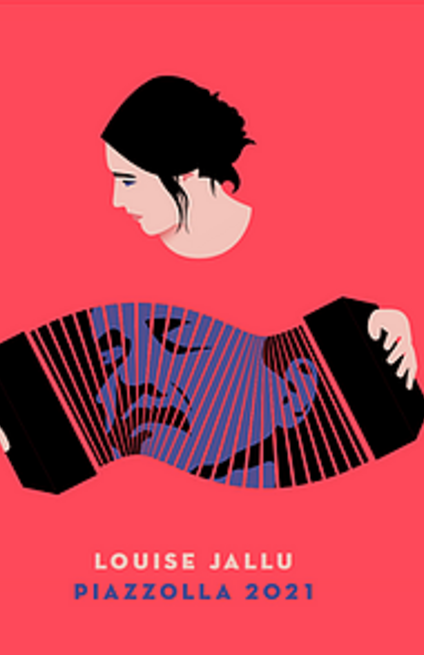
Louise Jallu pays tribute to the music of the great Argentine bandoneonist and composer.
Line-up
Louise Jallu – bandoneon, Karsten Hochapfel – guitar, Grégoire Letouvet – piano, Fender Rhodes, Alexandre Perrot – double bass
Artists
About us
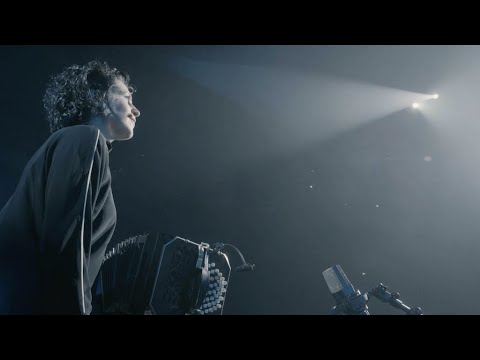
Louise Jallu does not aim to reproduce Astor Piazzolla’s (1921–1992) music to the letter, but rather to preserve its spirit and use it as a starting point for explorations that are as daring as they are impossible to pigeonhole into a single genre (tango, jazz, contemporary). This nuance is apparent from the very composition of the instrumental ensemble. Whilst the Argentine maestro had a quintet, the young French musician performs with a quartet. Their approach to the bandoneon also sets them apart. Whilst the ‘tiger’ Piazzolla makes his bellows roar, the ‘panther’ Jallu is content to let it breathe, gently (‘Soledad’) or with sensuality (‘Tanguedia’). Far from being limited to a simple arrangement, the work on the scores – a collaboration between the bandoneonist and the composer Bernard Cavanna – bears witness to a genuine creative endeavour. The extensions are numerous and of unexpected richness. For example, in the world-famous ‘Libertango’, in which the piano of the alchemist Gustavo Beytelmann joins the siren-like sound of an Edgard Varèse, or when another hit, ‘Oblivion’ (featuring Médéric Collignon’s ever-changing trumpet), concludes with a polyphony of music boxes. The revolution spearheaded by Astor Piazzolla led him to the Tango Nuevo; the one spearheaded by Louise Jallu results in Piazzolla Nuevo. Pierre Gervasoni, Le Monde
There have been numerous tributes to the master of tango nuevo, whose centenary is being celebrated in 2021. All too few have managed to rise to the level of this giant, who was already regarded as such during his lifetime. It is this Himalayan peak that Louise Jallu has dared to scale, not without the carefree spirit that characterises youth. At her side, the bandoneonist has been able to count on two experienced musicians: Bernard Cavanna, co-founder of the bandoneon department at the Gennevilliers Conservatoire, and the great pianist Gustavo Beytelmann, who had the good fortune to play alongside Piazzolla. These two know full well that to measure up to such a challenge, one must stay on course to grasp the full essence of Piazzolla’s ambivalence: drawing from the very heart of the deepest tradition to find the source of entirely new paths.
‘The more one immerses oneself in Piazzolla’s music, the more one realises that one must set aside the obvious and search within his “secret mechanics” – the ‘secret mechanics’ of his phrasing, his rhythmic breaks, his melodies that are constantly taut and expanding – new spaces, other possible directions, even if it means getting lost along the way, because deep down, we don’t really know where it will lead us,’ warns Louise Jallu, who chooses to scrutinise – and at times even dissect – a dozen pieces by this peerless melodist. Oblivion, Buenos Aires Hora Cero, Soledad, Adios Nonino and, of course, Libertango are thus featured in this collection.
The ‘little’ Frenchwoman, for her part, chooses not to play the revival card, preferring to break away from the original and forge her own originality from that foundation. In short, she plays in the spirit of the original, never to the letter.
‘If you claim to be bringing something new, it’s about doing something different. Taking hold of the music as if it were a standard and taking it somewhere else. ’ Far from sinking into a pale imitation, Louise Jallu instead opts for a reinterpretation that is as meticulous as it is critical, slowing the tempo, creating spaces for improvisation, restructuring the thematic material, opening up new harmonic paths, and reformulating the melody. In short, she adds her own commentary, much like footnotes, even if it means adopting a certain irreverence in order all the more to demonstrate her deep respect for the Argentine composer. This is a way of staying true to the unique post-modernity that characterised his work.
It is here that a meaningful reinterpretation of this master of subverting clichés can be crafted for those who know how to listen between the lines: here a stress, there intricately composed bars, further on a swaying rhythm, a modulation that unleashes frequencies, ambient sounds superimposed upon the mix – so many reconstructions that promise a future still under construction. This whole arsenal of creative possibilities, underlying the original scores, is skilfully utilised by Louise Jallu, as exemplified by the oblique lines traced by her quartet—comprising violinist Mathias Lévy, keyboardist Grégoire Letouvet and double bassist Alexandre Perrot—or by the extraordinary flugelhorn of Médéric Collignon, a guest on one track. An iconic presence, a ghostly evocation, a magnificent improvisation before returning to those few notes on an electric keyboard, whose echo lingers long after the sound has faded. As if it were the most natural thing in the world.
Jacques Denis
Gallery