Sankyoku – Japanese Chamber Music
Origin: Japan
Line-up
Mieko Miyazaki (koto, shamisen, vocal) - Fumie HIHARA (koto, shamisen, vocal) - Suizan Lagrost (shakuhachi)
Artists
About us
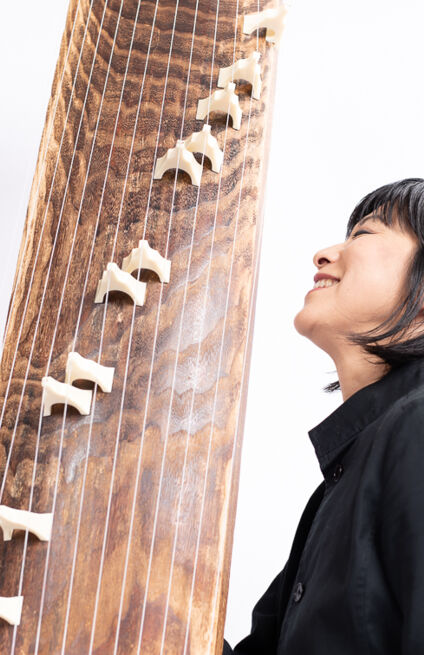
The ensemble style of music formed by these three instruments—the koto, shamisen, and shakuhachi—is called SANKYOKU. This term is also used as a synonym for traditional Japanese chamber music. “Traditional Japanese music” encompasses several genres: music related to religion, theater, agricultural work, and festivals; court music; and entertainment music enjoyed by cosmopolitan audiences.
Among these many genres, sankyoku is purely musical.
Sankyoku bears remarkable similarities to European chamber music: the instrument plays a central role, and specialized playing techniques and compositional methods have developed. Sankyoku underwent significant evolution from the 17th to the 19th century. It was the sankyoku musicians who were the first to join the modern music movement of the 20th century.
Mieko Miyazaki (koto, shamisen, and vocals)
Born in Tokyo, Mieko Miyazaki began studying the koto under Tomizo Huruya and Sachiko Tamura. After being admitted to the Tokyo National University of Fine Arts and Music, she was invited to perform as a soloist in the presence of the Imperial Couple of Japan. Selected by the Japan Foundation to represent Japan at international cultural events, she performed in Asia, Europe, and the United States, establishing herself as a leading concert artist. In 2005, she moved to France, at a time when she was still an unknown musician playing an instrument little known to European audiences. Her career quickly took on an international dimension. With the aim of introducing her instrument and Japanese music to a wider audience, she appeared on Jean-François Zygel’s “La boite à musique” on France 2 and on numerous programs on France Musique.
After 17 years of research and reflection, in 2020 she premiered the world premiere of her transcription of Bach’s “Goldberg Variations” for solo koto. In 2021, Mieko Miyazaki founded the first class in traditional Japanese music at the Gentilly Intercommunal Conservatory—the first such program offered at a public institution in Europe. There, she teaches the koto, the shamisen, and chamber music. In October 2025, she recorded *Pavillon d’Or*, a work by composer Philippe Chamouard, with the Nürnberger Symphoniker under the direction of Léo Warinski.
Fumie HIHARA (koto, shamisen, and vocals)
She began learning the koto at the age of 9, and then took up the shamisen at 15. She became a koto master at the age of 17, making her the youngest musician to earn a teaching certificate. A 1998 graduate of the Tokyo National University of Fine Arts and Music, Fumie HIHARA is a musician with an accomplished career, shaped both by the teachings of her masters and by a more theoretical and historical academic approach. As a performer and composer, she tackles a wide variety of genres with exceptional ease.
She is a true resource for specialist musicians, especially since she has maintained strong ties with her home country, Japan. She represents a school of koto music rarely heard in Europe and serves as a particularly valuable ambassador for it.
She has participated in numerous festivals and given concerts in Europe and Japan, including at UNESCO, the Lyon Opera, the Montpellier Opera, the Sainte-Chapelle, the Guimet Museum, and Radio France. She has performed with various musical ensembles such as Cie Prexinoscope (theater), the Ensemble 2e2m (contemporary music), XⅧ-21 Musique des Lumières (Baroque music), CAMKYTIWA, Fil d’Asie (Asian quartet), Karuta (musical storytelling), and Azur Quartet (jazz quartet), and has recorded seven albums.
Suizan Lagrost (shakuhachi)
Suizan J.-F. Lagrost is a renowned artist in both the worlds of traditional Japanese music and Western classical music. With a solid background in the transverse flute and as a winner of several national and international competitions, he began studying the shakuhachi in 2000 under the great master Sōzan Kariya. A Daishihan of the Tozan School of shakuhachi since 2014, Suizan is regularly invited to France and abroad for concerts, masterclasses, and to serve on the juries of international competitions. He performs in some fifteen countries around the world in chamber ensembles, as a soloist with major classical orchestras, and alongside the finest traditional musicians.
In 2020, he launched a series of profiles dedicated to Western shakuhachi players in *Hōgaku Journal*, a leading Japanese magazine. Equally at home in traditional styles as he is in contemporary music, he readily draws inspiration from other Asian musical traditions, as evidenced by the Japanistan trio (Afghan rubāb, shakuhachi, and Persian percussion), with which he released an album titled *Douce Errance* in 2024. His album of traditional Japanese music, *Kyoku - Japanese Chamber Music*, recorded in 2013 with koto player Mieko Miyazaki, was critically acclaimed and a resounding success. Suizan holds a DEA in 20th-century music (Sorbonne University) and currently teaches the transverse flute, the shakuhachi, and Japanese chamber music at the Kremlin-Bicêtre and Gentilly conservatories. He represents the Japanese ShinTozan-ryū school of shakuhachi in France.